
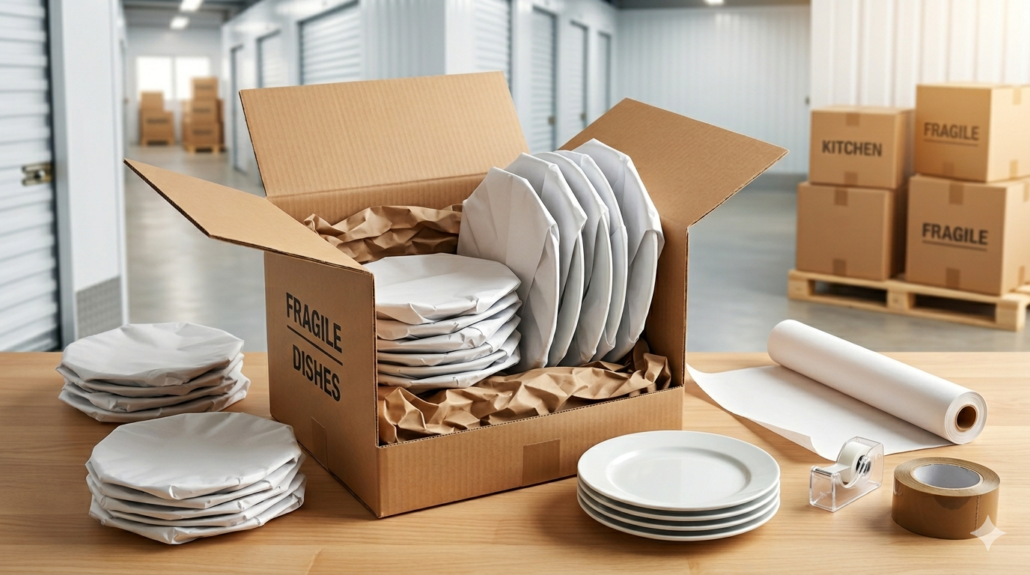
The Art of the Pack: How to Safely Store Your Dishes
Don’t let your favorite dinnerware become a collection of shards! Packing dishes for storage requires more than just a few old boxes and some tape. In this guide, the experts at Climate Masters Indoor Storage walk you through the essential “Pro-Tips” for protecting your kitchenware—from the “Golden Rule” of vertical plate stacking to the importance of choosing the right packing materials. Learn how to eliminate the “jiggle” and ensure your heirlooms and everyday sets stay crack-free, whether they are in transit or tucked away in one of our climate-controlled units.
Whether you’re moving into a new home in Summerville or clearing out kitchen clutter to make room for a renovation, your dishes are some of the most fragile items you’ll ever pack. At Climate Masters Indoor Storage, we see a lot of family heirlooms and fine china come through our doors. To ensure your kitchenware comes out of storage in the same condition it went in, you need a strategy.
Here is our professional guide on how to properly pack dishes for short-term or long-term storage.
1. Gather the Right Supplies
The biggest mistake people make is using “recycled” grocery store boxes. These are often thin and may have weakened over time. For dishes, you want:
- Dish Barrels (Dish Packs): These are double-walled, heavy-duty cardboard boxes designed specifically to handle the weight and fragility of plates and glassware.
- Packing Paper: Plain white newsprint is best. Avoid actual newspapers, as the ink can stain your ceramic or porcelain.
- Cell Kits: These are cardboard dividers that fit inside boxes to keep glasses and stemware from clumping together.
- High-Quality Packing Tape: Don’t skimp here. You need a strong seal to ensure the bottom of the box doesn’t give way.
2. The “Cushion” Method
Before a single plate goes into the box, you need a foundation. Crumple up several sheets of packing paper and create a 3-to-4-inch layer at the bottom of the box. This acts as a shock absorber during transit and while the box sits in your storage unit.
3. Wrap Individually (No Exceptions!)
It’s tempting to stack plates and wrap the whole pile, but this is a recipe for cracks.
- Place a plate in the center of your packing paper.
- Pull the corners over the plate until it is completely covered.
- For extra-fragile china, add a second layer of paper or a layer of bubble wrap.
4. Pack Plates Vertically
This is the “Golden Rule” of dish packing: Never stack plates flat. In a stack, the weight of the top plates puts immense pressure on the bottom ones. Instead, place your wrapped plates into the box on their edges (vertically), like records in a crate. They are much stronger in this position and less likely to shatter if the box is bumped.
5. Packing Glasses and Bowls
- Bowls: These can be “nested.” Wrap one bowl, place it inside another, and then wrap both together. However, always place heavier bowls at the bottom of the box.
- Glasses: Stuff the inside of the glass with crumpled paper to reinforce the structure. Use cell kits to keep them upright. Never lay wine glasses or stemware on their sides.
6. Eliminate “The Jiggle”
Once your box is full, gently give it a tiny shake. Do you hear anything moving? If so, you need more padding. Fill every “dead air” space with crumpled paper, dish towels, or even clean socks. A box that is packed tightly is a box that survives the move.
7. Labeling and Stacking in Your Unit
Label your boxes “FRAGILE – DISHES” on at least two sides and the top. Use arrows to indicate “THIS SIDE UP.”
When you bring your items to your Climate Masters unit, remember to:
- Keep them off the floor: Even in a clean, climate-controlled environment, it’s best practice to stack dish boxes on top of heavier, sturdier furniture or pallets.
- Don’t stack too high: Never place more than two or three dish boxes on top of each other to prevent the bottom box from crushing.
Why Climate Control Matters for Dishes
You might think dishes don’t need temperature control, but extreme heat and humidity can cause some glazes to “craze” (develop tiny surface cracks) or cause packing tape and cardboard to degrade over time. By choosing Climate Masters Indoor Storage, you’re giving your kitchenware a stable, clean environment that preserves its value and beauty.
Need packing supplies or a tour of our Summerville, Hanahan, or Daniel Island facilities? Stop by and see us today—we’re here to help you store with confidence!